Peptide Therapy
Precision Peptide Therapy. Not Signals. Instructions.
Most people have heard about peptides. Very few understand them. And almost nobody in medicine is using them the way they were designed to be used.
“A peptide is not a drug. It is a biological instruction. And like any instruction, what matters is not just the message — it is whether the system is ready to receive it, and whether the message was designed for you.”
Before you read further, watch the video below. Carlos and Miguel break down what a peptide actually is in plain English. Everything that follows will land differently once you understand the foundation.
The Problem Isn't the Peptide. It's the Protocol.
Here is what the peptide industry never tells you: Most peptide protocols are being used in the wrong order, at the wrong time, on a system that is not ready to receive them. The peptide is not the failure. The logic is.
Peptides are signals. Signals are instructions. Instructions only work when the system is listening. You cannot send a message to a broken receiver. You cannot send a growth signal into an inflamed, insulin-resistant, sleep-deprived body and expect it to perform. You get noise. You waste money. And worse — you waste biological opportunity.
“Introducing a growth hormone peptide into an insulin-resistant body is like turning up the volume on a radio with unplugged speakers. The signal is perfect. The system cannot hear it.”
After more than a decade in clinical practice, thousands of patients, and tens of thousands of labs analyzed — this is the pattern we kept seeing. Peptides worked when they were used deliberately, sequenced correctly, and layered on top of a prepared system. They failed when they were stacked impulsively and treated like supplements. The problem was never the compounds. The problem was the common sense behind how they were being used.

Your Body Does Not Run in a Straight Line. Neither Should Your Protocol.
Human biology is not linear. It is seasonal, rhythmic, and adaptive. Your immune system is not the same in January as it is in July. Your hormones do not fire continuously — they pulse. Your mitochondria shift behavior based on light, temperature, food, and stress. Your gene expression follows cyclical patterns tied to environmental signals that go back thousands of years.
And yet — the entire peptide industry runs flat, year-round protocols as if the body is a machine with one setting.
“Treating a cyclical organism with a continuous flat protocol is like driving at full throttle all year and wondering why the engine blows. Biology adapts by contrast — not by constancy.”
What actually produced consistent, durable results in our clinical practice was something far less exciting and far more effective: respecting biology's timing. MHI structures peptide therapy using a seasonal biological framework — aligning signals with the dominant biological state of each phase of the year, so the body is not working against the protocol. It is working with it.
The Four Biological Seasons
Winter
Repair & Restore
Priority: cellular cleanup, immune resilience, inflammation reduction. Signals focused on recovery and system reset.
Spring
Rebuild & Prime
Priority: mitochondrial reactivation, hormone priming, metabolic reawakening. Laying the foundation for expression.
Summer
Perform & Express
Priority: growth, anabolism, cognitive output, peak metabolic demand. The season for performance peptide signals.
Fall
Consolidate & Protect
Priority: antioxidant defense, detox support, immune preparation. Transitioning from output back toward repair.
No phase is more important than another. The biology demands all four. Ignoring one is like running a company where every resource goes to sales while accounting, operations, and R&D receive nothing. It works — briefly. Then everything breaks.
This is not a marketing framework. This is how physiology actually operates. MHI is one of the very few clinical practices in the country using peptides with this level of biological organization behind it.
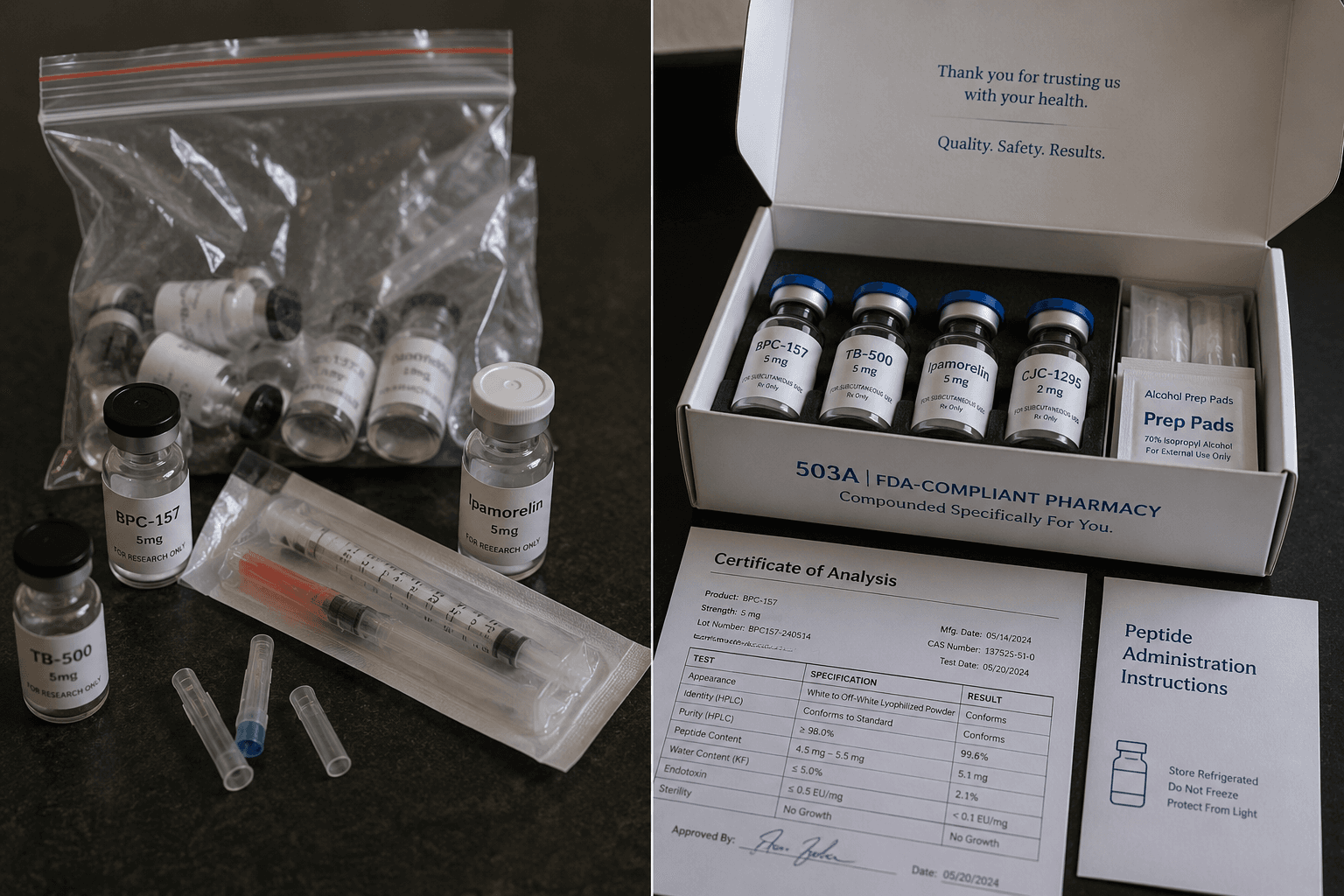
Never Touch Research Peptides. Here Is the Exact Reason Why.
This section exists because it needs to be said clearly once—and then never revisited.
Products labeled 'not for human or animal use' or 'for research use only' are not a gray area. They are a legal disclaimer designed to protect the manufacturer when something goes wrong inside your body. The warning is not fine print. It is a confession.
A peptide is a biological instruction. The sequence of amino acids must be exact. One misplaced amino acid changes the entire message. Consider BPC-157 — a peptide chain of 15 amino acids. With 20 possible amino acids at each position, the number of possible sequences is 20 raised to the power of 15. That is 32 thousand trillion possible sequences. Only one is BPC-157. One.
“When you inject a research-grade peptide, you are not biohacking. You are volunteering your body as a lab rat for a company that openly states it cannot verify what is inside the vial.”
Research Peptides vs. Medical-Grade Peptides
| Research Peptides (Online / "For Research Use Only") | MHI Medical-Grade Peptides (503A / FDA-Compliant Pharmacies) |
|---|---|
| No sterility testing required | Full sterility verification — free from bacterial/microbial contamination |
| No endotoxin testing — inflammatory toxins may be present | Endotoxicity confirmed — no inflammatory bacterial byproducts |
| HPLC purity is the only test performed | HPLC + LC-MS/MS + amino acid analysis + sequence verification |
| No structural validation — peptide may be misfolded | Optical rotation / Circular Dichroism confirms correct folding |
| No heavy metal screening | Elemental analysis — all heavy metals screened |
| Purity often 68–92% — unknown material in remainder | 99.6%+ pharmaceutical-grade purity — verified lot by lot |
| Certificates of Analysis may be recycled or fabricated | Third-party batch testing — every vial verified independently |
| No dosing protocols. No medical oversight. | Supervised by licensed clinicians. Protocols built around your labs. |
| If something goes wrong — manufacturer is legally shielded | Licensed pharmacy and clinical oversight — accountability throughout |
The consequences are not theoretical. Infections. Inflammatory reactions. Erratic cardiac events. Neurological symptoms. Liver stress. These are the real stories that walk into clinical practices after people decide to save money on something they inject directly into their body.
Medical-grade peptides are not more expensive because of branding. They are more expensive because of what goes into verifying that the compound in the vial is exactly what it claims to be — structurally intact, sterile, sequenced correctly, and safe for human use.
If a company cannot or will not guarantee what is in the vial, that is not a minor caveat. That is the entire problem. Saving money on peptides you inject is not being smart. It is cutting corners with your biology — and eventually, biology collects.
When Seasonal Precision Is Not Enough: The Joker Card.
Everything described above — seasonal sequencing, signal timing, pathway hierarchy, medical-grade sourcing — represents the highest standard of conventional precision peptide therapy. But it is still built on a fundamental assumption: that off-the-rack peptides, applied with great timing and clinical precision, are the best available tool. They are not. Not anymore.
“Think of standard peptides — even the best ones, sourced correctly, sequenced seasonally — as premium software built for millions of users. It works well. But it was designed for the average. Neo7 is custom code written specifically for your operating system. Same language. Completely different program.”
The Shift From Top-Down to Bottom-Up
Every conventional peptide strategy works the same way. You introduce a signal at the top. That signal travels through a pathway. The pathway activates a system. If everything downstream is functioning correctly, you get a result. The problem: most people's systems are not functioning cleanly. Pathways are noisy. Receptors are dulled. Mitochondria are dysfunctional. Hormone signaling is out of rhythm. The system is inflamed. When you send a signal into that environment — even a perfect signal — it echoes through a distorted system.
Neo7Bioscience inverts the model entirely. Neo7 does not start with the signal. It starts with the system — restoring the environment first, so that when signals are introduced, the body actually responds.
“Instead of shouting instructions from the top and hoping the message makes it through, Neo7 goes directly to the source — the cellular machinery itself — and restores the environment where signaling actually makes sense.”
How the Technology Works: Three Layers
PBIMA — Precision Biological Intelligence Mapping Architecture
Your entire genome — approximately 60,000 genes — is mapped using High-Definition Long-Read Sequencing (LRS). Not the fragmented, short-read sequencing used by standard consumer tests. Full genome visibility. Unmatched accuracy. PBIMA does not wait for dysfunction. It identifies pathways under strain, survival programs beginning to activate, and subtle biological drift — long before symptoms appear or standard labs show anything abnormal. It is not a test. It is a biological blueprint.
REViSS — Personalized Peptide Signal Design
Once the blueprint is complete, REViSS designs a peptide sequence specifically for your genetic architecture. Not selected from a catalog. Engineered from your data. These are not generic compounds with your name on the label. They are layered peptide formulations — multiple signals in one coordinated design, each influencing a different biological network, built to work together rather than in isolation. The body does not respond best to louder messaging. It responds to clearer messaging. REViSS organizes the signals so they make sense together.
Adaptive Host Intelligence — The System That Evolves With You
Most protocols are static. Biology is not. Adaptive Host Intelligence continuously refines the peptide design as your biology changes, forming a closed loop: Measure → Design → Adapt → Repeat. Not a fixed protocol. A living system.
From our clinical experience over three years using this technology: unlike conventional peptide strategies that require repeat cycles year after year, these personalized corrections often require only one to three rounds. Once the architecture is recalibrated, the stability can hold for many years — in some cases a decade or longer.
And here is what makes it even more significant: once the system is recalibrated, any future signaling — including standard, off-the-shelf peptides — begins working significantly better. Because the underlying environment is no longer distorted. The signal finally reaches a system that can hear it.
What Recalibration Actually Looks Like
When Miguel and Carlos underwent their own PBIMA mapping and Neo7 recalibration, they expected modest improvements. What they found was something else entirely.
Klotho — a master longevity gene influencing mitochondrial function, DNA repair, and metabolic signaling — improved by more than 82% for Miguel. His brother's Klotho improved by over 120%. CD38, which regulates NAD metabolism and cellular energy, improved by over 42%.
These are not supplement-level shifts. These are architectural changes. And Klotho and CD38 are simply the two gene pathways the Bertonatti brothers chose to show you — out of thousands of gene pathways that shifted in the same report. This is what recalibration looks like when it happens at the level of the system itself, not the symptom.
“We were genuinely stupefied. We were on testosterone, running growth hormone peptides, taking desiccated thyroid — feeling like absolute machines. Performance up. Body composition dialed. Mentally sharp. By every measure we could see, we were winning. And then the data showed us what we couldn't see. All of those therapies we were feeling so good on were generating toxic metabolic byproducts — and our bodies were not recycling or clearing them efficiently. On the surface, we looked great. Internally, we were slowly rotting. That was the gut punch. Neo7 didn't just show us a problem — it showed us the blind spot that no other tool in medicine had ever revealed. And it changed everything about how we think about optimization.”
This is what happens when precision medicine moves from estimation to engineering. Not louder signals. Not more stacking. A surgically precise, bottom-up restoration of the system itself — so when signals are introduced, the body responds the way it was designed to.
This Level of Precision Is Not For Everyone.
MHI does not operate like a peptide clinic. We do not prescribe off a menu. We do not run the same protocol on every patient. We evaluate the system. We correct the terrain. We sequence the signals in the right order. And for the right candidates, we apply the most advanced personalized peptide technology available anywhere in the world. If you have already spent time and money on peptides and wondered why the results were inconsistent — this is the answer. The signal was not the problem. The system receiving it was. If you have never used peptides but understand that your biology deserves a level of precision that most clinics cannot offer — this is where that conversation begins.
MHI services are not covered by health insurance.